


Google Ads vs Meta Ads: Which One Actually Gives You Better ROI?
At least once a week, a client asks me some version of the same question. Sometimes it’s before they’ve spent a rupee. More often it’s after — after the budget’s gone and they’re staring at a spreadsheet trying to figure out what happened.
“Should I be on Google Ads or Meta Ads?”
I used to try giving a clean answer. I don’t anymore, because there isn’t one. Both platforms can make you real money. Both can also quietly burn through a budget if you don’t understand what they’re actually built to do. The question isn’t which platform wins in some abstract sense — it’s which one matches how your specific customers behave before they hand over their card details.
So let’s actually get into it.
Google Ads: You're Catching People Mid-Search
The thing that makes Google different from basically every other ad platform is intent. Someone typing “emergency plumber near me” at 11pm isn’t browsing. They have a burst pipe and they want it fixed. Someone searching “best CRM for a 10-person sales team” has probably already tried two other tools and is done wasting time.
Your ad isn’t trying to convince anyone they need something — the need already exists. It just has to show up and make a decent case for why you’re the one to call.
That’s a genuinely big deal, and it’s why service businesses lean on Google so heavily. Lawyers, hospitals, real estate agents, agencies like mine — these are all purchases people research before making. Google catches them right in the middle of that research.
And honestly, that timing is worth more than almost anything else in advertising — you’re not hoping someone becomes interested, you’re just being there when they already are.
A few reasons it tends to work:
People searching are already motivated — nobody Googles something they’re not at least a little serious about. It’s strong for lead gen, especially anything with a higher price tag attached. The scale is massive too, billions of searches a day means you’re rarely short on volume. And the targeting can get weirdly specific once you dig into keywords, device type, location, even what someone did on your site three weeks ago.
Now the part nobody likes talking about. Competition is brutal in certain categories. I’ve personally watched insurance and legal keywords hit four figures per click — and that’s not a typo. If you’re not actively managing bids and negative keywords, you can spend a lot and end up with very little to show for it. This is not a platform you launch and walk away from.
Meta Ads: Getting Noticed Before Anyone's Actually Looking
Facebook, Instagram, Messenger — Meta’s whole ecosystem plays a different game entirely. Nobody opens Instagram thinking “today’s the day I find a new skincare brand.” They’re there to see what a friend posted, watch a few reels, kill ten minutes that somehow turns into forty. Your ad shows up somewhere in the middle of that.
Meta isn’t catching demand. It’s creating it, or at least trying to.
I’ve seen small jewelry and clothing brands go from nothing to a real customer base off one reel that happened to take off. That basically never happens with a Google Search ad — but on Meta, it’s not even that rare.
Why it works when it works: the interest and behavior targeting is unnervingly good — sometimes it feels like Meta knows what you want before you do. Video and carousel formats are perfect for anything that needs to be seen to make sense. Clicks and impressions are generally cheaper than on Google. And the Pixel lets you follow up with anyone who so much as looked at a product page and didn’t buy.
Here’s the catch, though — and it’s a real one. Since nobody’s actively searching, your intent is borrowed, not earned. You’re interrupting a scroll, not answering a question someone already had. Which means the creative has to do almost all the work. If the first couple of seconds don’t land, they’re onto the next reel and you’ve lost them for good. I’ve seen campaigns with great targeting completely underperform purely because the video was boring.
That’s the trade-off nobody mentions when they tell you Meta is ‘cheaper.’ You’re not paying less for attention, you’re just paying for a different kind of attention — one you have to earn in the first three seconds instead of getting handed to you by search intent.
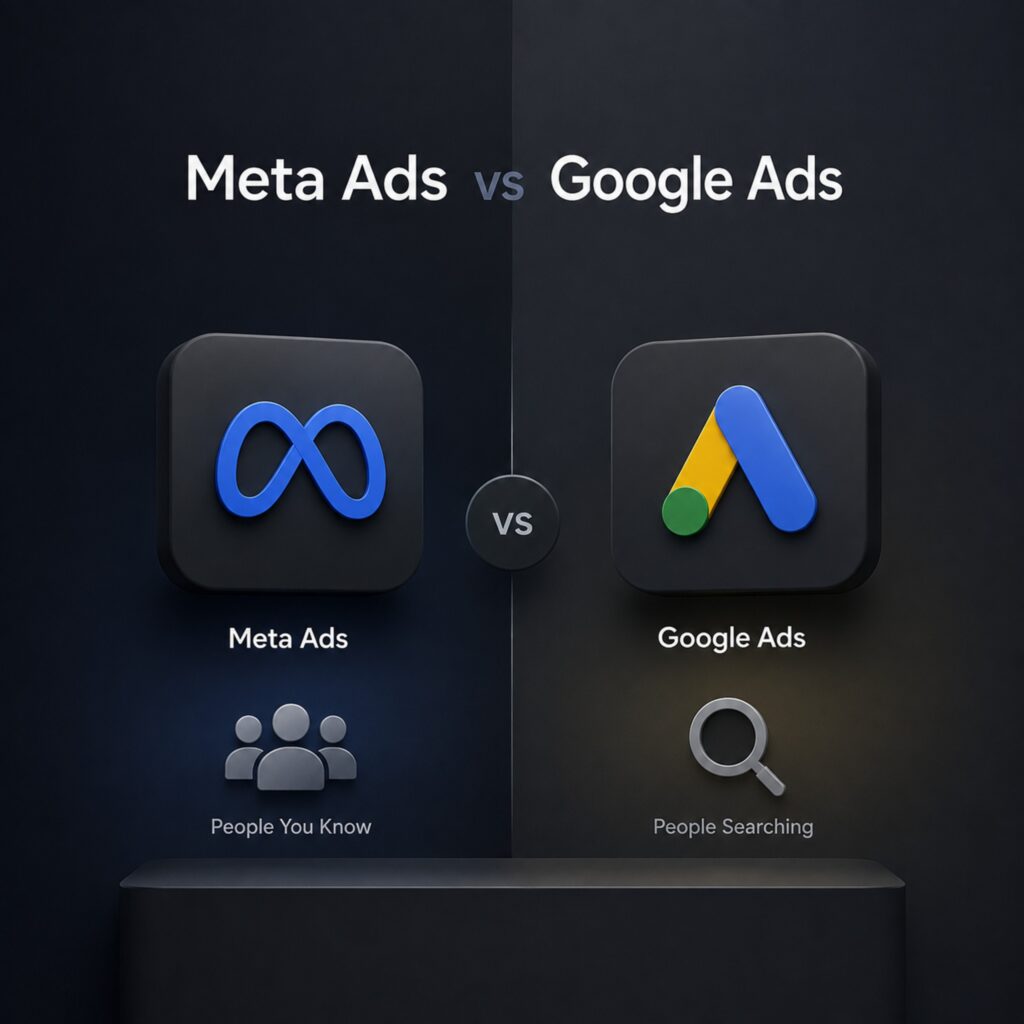
Comparing Them Head to Head
On intent, Google wins, easily. Someone typing “best interior designer in Bangalore” is much closer to buying than someone who just noticed your Instagram ad thirty seconds ago.
On awareness, Meta takes it. It’s built for the “never heard of you before” moment.
Lead quality usually leans Google, especially for anything expensive. Meta can absolutely generate leads — sometimes a lot of them — but they tend to need more convincing before they turn into actual customers.
Cost is genuinely situational. Google’s clicks cost more because you’re bidding against everyone else who wants that same keyword. Meta is usually cheaper to reach people with. But cheap traffic that never converts isn’t cheap, it’s just slower to notice you’ve wasted money. I’d rather have ten serious leads than a hundred people who filled out a form and vanished.
Creative work is heavier on Meta, no question. Google cares about headlines and your landing page. Meta cares about whether your video is actually worth three seconds of someone’s attention.
Which One Fits Your Business
If people research before buying from you — real estate, legal work, healthcare, financial planning, home repairs — start with Google. You’re meeting them at the exact moment they’ve decided to act.
If what you sell needs to be seen and felt before someone wants it — clothing, food, beauty products, furniture, anything lifestyle-driven — Meta is probably the better starting point. These are purchases led by emotion as much as logic, and Meta is built for that.
Honestly, Why Choose At All
The clients I’ve worked with who get the strongest returns almost never pick just one. They run both, and it tends to play out something like this: someone scrolls past a reel on Meta, gets curious, maybe checks out the website without buying anything. A week later they do their own research and Google your name, and there’s your search ad, right when they’re ready to decide. Remarketing on both platforms keeps nudging them the whole way through.
That’s not a coincidence — it’s basically how people already make decisions. Discover something, think about it, hesitate, eventually act. Running both platforms just means you show up at every one of those steps instead of only one.
What Actually Moves the Needle, Regardless of Platform
A handful of habits consistently separate campaigns that make money from ones that quietly lose it:
Know your goal before you spend a single rupee — leads, sales, sign-ups, whatever it is. Send traffic to a dedicated landing page, never your generic homepage. Set up real conversion tracking (an embarrassing number of businesses skip this entirely). Test more than one headline, image, or audience instead of guessing which will work. Check in on campaigns weekly at minimum — nothing performs well on autopilot forever. Pay attention to CPL, ROAS, and conversion rate, not just how many people saw the ad. And keep adjusting targeting as real data comes in, because your first guess is rarely your best one.
Bottom Line
If you need a one-line answer: pick Google when you want people who already know what they need. Pick Meta when you’re trying to build awareness where none exists yet.
But if I’m being straight with you, most businesses seeing real, lasting ROI aren’t choosing one over the other. Meta gets them noticed. Google closes the loop once they’re ready to buy. Run them as teammates instead of rivals and your budget will go a lot further than you’d think.
If you’re still not sure which platform deserves more of your budget right now, that’s exactly the kind of thing worth figuring out before you spend another rupee guessing. Book a free consultation with Digital Hike, and we’ll go through your specific offer, audience, and goals to tell you honestly where your money should actually be going. Call us at 9187138887 / 9632811130.