


Is Social Media Necessary for Every Business? Here's What You Need to Know
Ask ten business owners if social media is worth the effort and you’ll get ten different answers. Some swear by it. Others have built solid, profitable businesses without posting a single reel. So who’s right?
Honestly, both can be true at once. Not every business needs to be on every platform — and plenty of companies get by just fine without a big social presence. But most businesses, even the ones that don’t sell directly through Instagram or TikTok, still benefit from having some kind of strategic presence online. The trick is figuring out what “strategic” actually means for you, instead of just posting because everyone else is.
People Don’t Trust What They Can’t Find
Think about the last time you hired someone or bought from a business you’d never used before. Did you just take their word for it? Probably not.
You looked them up. Maybe you checked their Instagram, read a few Google reviews, or scrolled their LinkedIn to see if they seemed legit.
That’s the world we’re in now. A business can be completely legitimate and still come across as sketchy or out of touch if there’s nothing to find when someone searches for it. People don’t necessarily expect you to be everywhere, but they do expect you to be somewhere — a place where they can see recent work, read what other customers think, and get a sense of who they’re dealing with before they commit.
Why It's Worth Paying Attention To
It gets your name in front of people who’ve never heard of you. Every post is a small chance for someone new to stumble across your business. It’s not a one-off ad campaign — it’s ongoing, and it adds up over time.
It builds trust in a way ads can’t. A polished ad tells people what you want them to hear. A real, active profile — with actual customer feedback, behind-the-scenes moments, or a face behind the brand — tells them something closer to the truth. That matters more than most business owners give it credit for.
It opens a direct line to your customers. Someone can comment, DM you, or tag you, and you can respond right there, in public, in real time. Try doing that with a billboard. This back-and-forth is honestly one of the more underrated parts of social media — it’s customer service and market research rolled into one.
It can actually generate leads, not just likes. A lot of business owners write social media off because they’re chasing followers instead of outcomes. But a well-placed how-to video, a case study, or even a simple “here’s what we do” post can nudge someone toward booking a call or checking out your site. The follower count was never really the point.
It’s cheap compared to almost everything else. You can start posting for free tomorrow. If it works, you scale it with a small ad budget. Try getting that kind of low-risk entry point with a billboard or a radio spot.
You Don't Need to Be Everywhere
This is probably the biggest myth out there — that a “real” business needs a presence on Instagram, Facebook, LinkedIn, TikTok, and YouTube all at once. It doesn’t. In fact, trying to do all of it usually means doing none of it well.
It’s more useful to think about where your actual customers hang out:
If you’re a restaurant, boutique, or anything visual, Instagram tends to do the heavy lifting.
B2B companies, consultants, and recruiters often get more mileage out of LinkedIn than anywhere else.
Local shops and service businesses lean on Facebook for community and events.
If you’ve got something worth explaining or demonstrating, YouTube is hard to beat.
Chasing a younger crowd? TikTok’s short-form format is where the attention is.


Pick one or two platforms and actually show up consistently, rather than spreading yourself thin across five and posting nothing worthwhile on any of them.
Can You Skip It Entirely?
Sure. Plenty of businesses run on word-of-mouth, referrals, or long-standing contracts and never touch social media in any meaningful way. Highly specialized B2B firms often fall into this camp.
But here’s the catch — even a referral doesn’t happen in a vacuum anymore. Someone recommends you, and the person on the other end still goes and looks you up. If they find nothing, or worse, an abandoned profile that hasn’t posted since 2021, it can quietly undercut the trust that referral was supposed to build. Social media doesn’t have to be your main growth engine to still be doing something useful in the background.
Where Most Businesses Go Wrong
Having an account isn’t the same as having a strategy. The businesses that get frustrated with social media are usually making one of these mistakes:
Posting in bursts, then disappearing for weeks
Treating every post like a sales pitch
Never replying to comments or DMs
Copying whatever a competitor is doing instead of finding their own voice
Posting without really knowing who they’re talking to
Obsessing over follower counts instead of actual engagement
None of these are fatal, but they’re the difference between an account that does something for the business and one that just sits there.
Connecting the Right Pieces
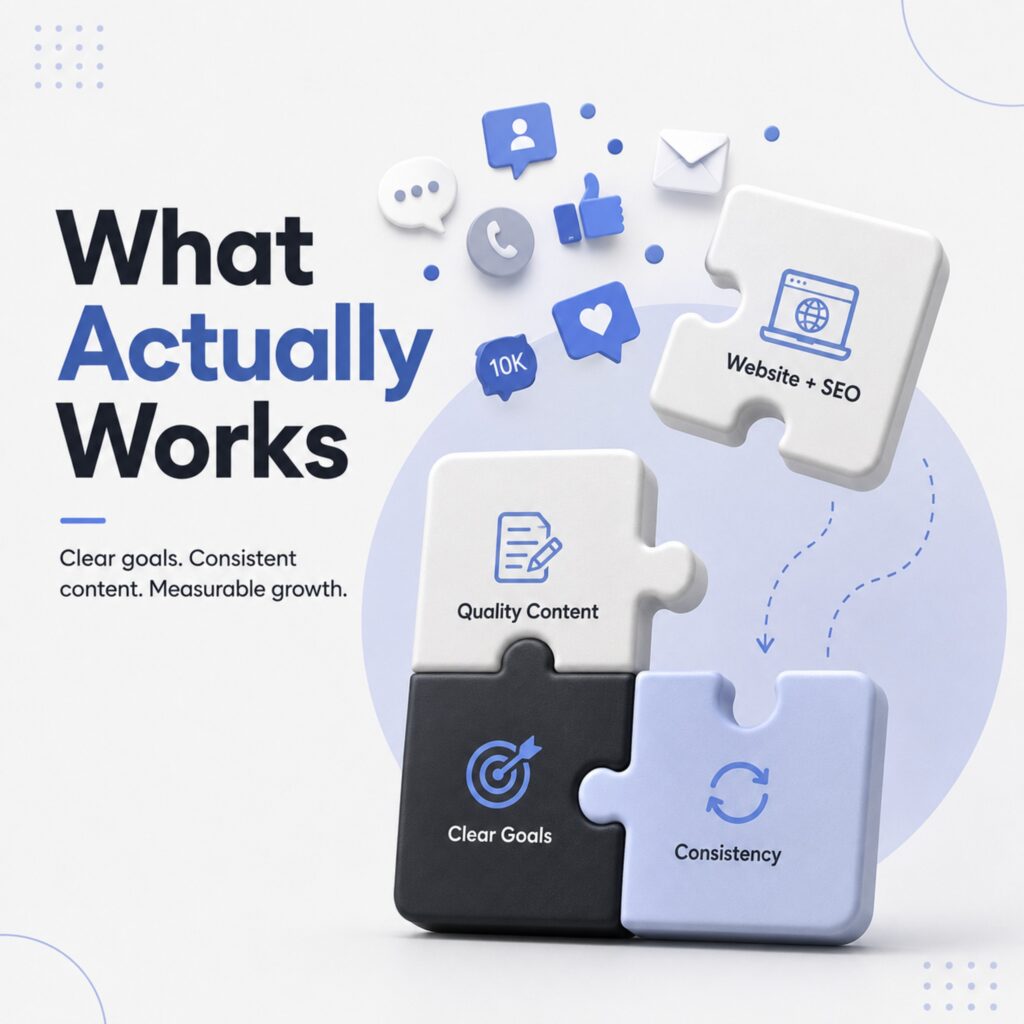
Start with what you’re trying to accomplish — more brand awareness, more leads, more traffic to your site, better relationships with existing customers. That answer should shape what you post, not the other way around.
From there, the businesses that see real results tend to have a few things in common: a look and tone that stays consistent, content that teaches or entertains rather than just sells, a mix of promotional and non-promotional posts, and testimonials or case studies mixed in naturally. And critically — they track what’s working and adjust, instead of guessing forever.
One thing worth remembering: posting three times a week with something genuinely useful will usually beat posting daily just to hit a quota. Nobody’s following you for volume.
It’s One Piece, Not the Whole Puzzle
Social media rarely works well on its own. It tends to perform best alongside a decent website, some SEO groundwork, email marketing, a Google Business Profile that’s actually filled out, and maybe some paid ads once you know what’s converting. Each piece catches people at a different point in the process — social media might be where someone first hears about you, but your website is often where they decide to actually buy.
So, Do You Need It?
There’s no universal answer here, and anyone who tells you otherwise is probably selling something. Not every business needs to post daily. Not every business needs five platforms — most don’t even need three. But in a world where people research before they buy almost everything, having some kind of presence, even a modest one, tends to help more than it hurts.
The better question isn’t “do I need social media.” It’s “what would social media actually do for my business if I used it well?” For some businesses, the honest answer is “not much.” For most, though, it’s a lot more than they’d expect — provided they treat it as a real part of the business instead of an afterthought.
If you’re not sure which platform deserves more of your budget right now, that’s exactly the kind of thing worth figuring out before spending another rupee guessing. Book a free consultation with Digital Hike, and we’ll walk through your specific offer, audience, and goals to tell you honestly where your budget should actually be going. Call us at 9187138887 / 9632811130.