
REAL ESTATE BUILDERS ARE WASTING CRORES
Walk into the marketing meeting of almost any mid-sized real estate developer and you’ll hear some version of the same complaint: “We’re spending lakhs every month on ads and getting hundreds of leads, but almost nobody is actually booking a unit.” The budget is real. The leads are real. The sales aren’t. And nobody in the room can quite explain why. The answer is rarely “we need to spend more.” It’s usually that the entire funnel was built around the wrong metric from the very beginning.
THE LEAD VOLUME TRAP
Real estate marketing in India has developed a strange obsession with lead count. Agencies pitch on it. Developers measure success by it. “We generated 800 leads this month” sounds impressive in a review meeting. But a lead is not a customer, and treating the two as interchangeable is where most of the wasted budget quietly disappears.
A campaign optimized purely for lead volume will always produce more leads. It will also, predictably, produce worse ones — people who clicked out of curiosity, entered a fake number for a freebie, or were never within the property’s budget range in the first place. Sales teams end up spending their entire day chasing unqualified contacts instead of talking to the handful of people who were genuinely ready to buy.
Flip the optimization goal from “cheapest cost per lead” to “cost per genuinely qualified lead,” and the number of leads usually drops. The number of site visits and bookings, in almost every case Digital Hike has worked on, goes up.

WHY CRORES GET BURNED ON THE WRONG THINGS
- Broad targeting instead of intent-based targeting. Ads shown to anyone in a city, instead of people actively searching for property, comparing loans, or researching a specific micro-market, generate volume but not quality.
- No pre-qualification layer. Without a budget or intent filter before someone’s contact reaches a salesperson, the sales team burns hours on people who were never in the right price bracket.
- Generic creative across every project. The same ad template reused for a luxury villa and an affordable apartment ignores the fact that these are completely different buyers with completely different decision triggers.
- Zero retargeting. Real estate has one of the longest decision cycles of any purchase — often months. A single ad click that isn’t followed up with retargeting is treated as a lost opportunity instead of the beginning of a long nurture cycle.
- No visual proof for under-construction projects. Asking someone to commit lakhs, or crores, of rupees based on a flat 2D floor plan and some renders is asking a lot of imagination from a buyer who has other options with better visualization.
THE FIX: BUILDING A FUNNEL AROUND INTENT, NOT VOLUME
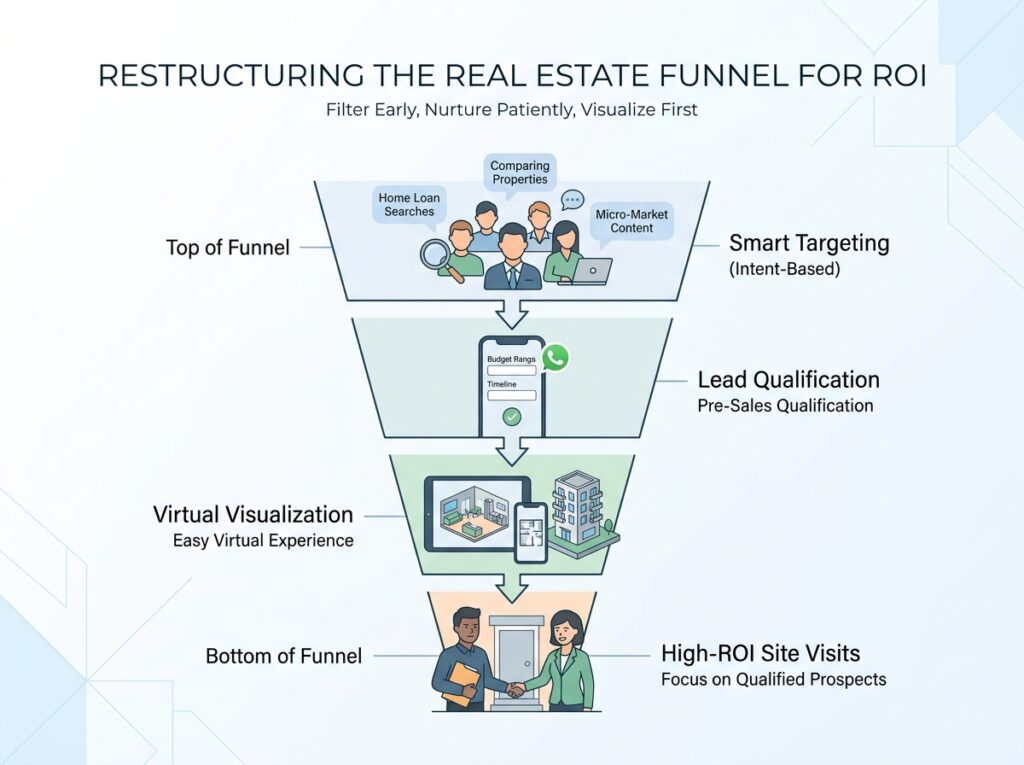
The developers seeing genuinely strong ROI right now have restructured their funnels around a simple idea: filter early, nurture patiently, and make the property easy to visualize before the site visit even happens.
That starts with targeting people showing real buying signals — searching for home loans, comparing similar properties, or engaging with content specific to the micro-market — instead of broad demographic targeting that just happens to include a lot of people who’ll never buy anything. It continues with a qualification step before a lead ever reaches a salesperson: a short form or WhatsApp flow that captures budget range and timeline, so the sales team spends its time on people who can actually afford the property, not everyone who clicked an ad.
WHERE 3D VISUALIZATION CHANGES THE GAME
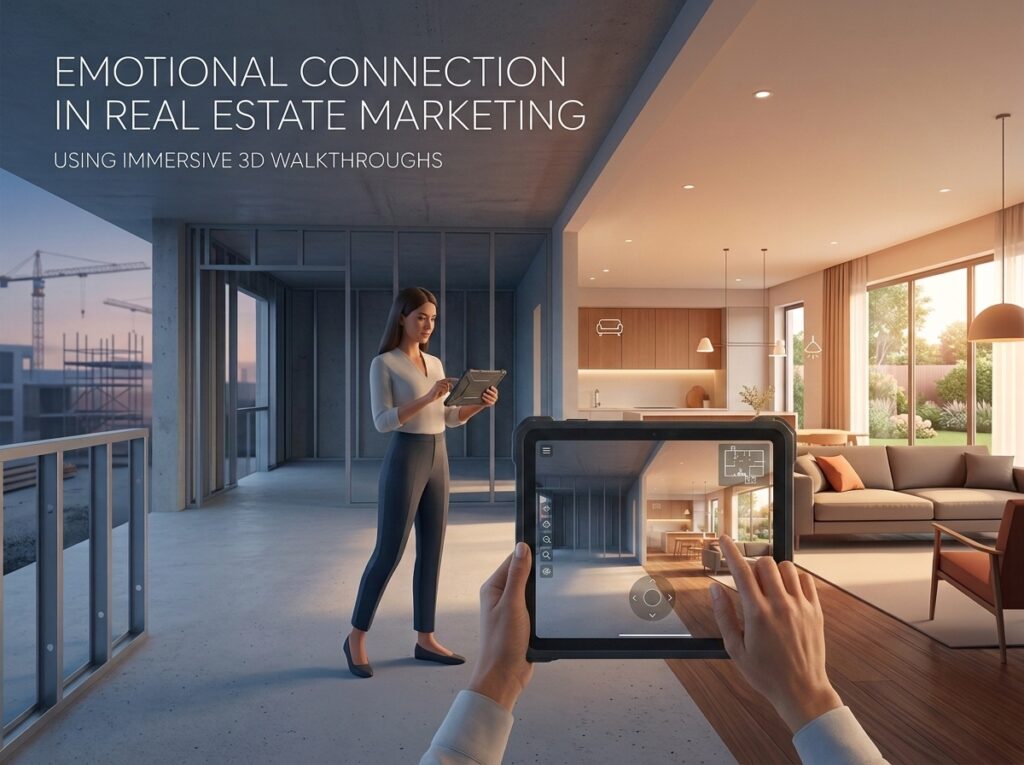
One of the more underused tools in real estate marketing right now is immersive 3D walkthroughs, especially for projects that are still under construction. A floor plan asks a buyer to imagine an entire home from a flat line drawing. A 3D walkthrough lets them actually walk through it — see the light in the living room, understand the flow between kitchen and dining, picture their furniture in the space — before a single brick has been laid.
This matters more than it might sound like on paper. Property is an emotional purchase as much as a financial one, and emotional decisions are made from vivid imagination, not abstract floor plans. Developers using high-quality 3D visualization alongside targeted ad funnels consistently see stronger site-visit-to-booking conversion, because by the time a prospect walks into the actual sales office, they’ve already emotionally pictured living there. The site visit becomes confirmation, not discovery.
NURTURE, BECAUSE NOBODY BUYS PROPERTY ON THE FIRST CLICK
Real estate decisions rarely happen in a single session. A buyer might see an ad, research the developer, compare two or three projects, discuss it with family, revisit their budget, and only then decide to book a site visit — a process that can stretch across weeks or months. A funnel that gives up after one ad click is giving up right before the real decision-making process even begins.
A proper nurture sequence — retargeting ads, WhatsApp follow-ups, email updates on construction progress, invitations to site visit events — keeps the property front of mind through that entire window. Most of the crores wasted in real estate marketing aren’t wasted on the first click. They’re wasted on the absence of everything that should happen after it.
WHAT DIGITAL HIKE HAS SEEN WORK
In work with real estate developers, the projects that convert well share a consistent pattern: intent-based targeting instead of broad reach, a qualification step before leads reach sales, immersive 3D visualization for under-construction inventory, and a retargeting and nurture sequence that respects how long property decisions actually take. None of these individually is revolutionary. Together, they change a funnel from a lead-generation machine into an actual sales engine.
The uncomfortable truth for a lot of developers is that the fix isn’t a bigger budget. It’s usually a smaller, better-targeted budget spent on a more disciplined funnel — which is a harder conversation to have in a review meeting than “let’s increase spend,” but a far more profitable one over the life of a project.
Digital Hike has built end-to-end real estate marketing systems — from 3D walkthroughs to intent-based ad funnels — that turn ad spend into site visits and site visits into bookings. If your lead numbers look good but your booking numbers don’t, book a free strategy call and let’s find out where the funnel is actually leaking.
It’s worth remembering that a real estate purchase is one of the highest-stakes decisions most buyers will ever make, and the marketing funnel around it should reflect that weight. A buyer comparing a two-crore apartment against three other options isn’t going to be swayed by a generic ad and a rushed phone call. They’re going to be swayed by whichever developer made the decision feel the safest and the clearest — through better visualization, more patient follow-up, and a sales process that respected how big a decision this actually is. That, far more than ad spend alone, is usually what separates the projects that sell out from the ones still running the same campaign eighteen months later.