
AI Won't Replace Marketers. This Will.
There’s a specific kind of anxiety going around marketing teams right now, and it usually sounds like this: “AI is going to take my job.” It’s a reasonable fear on the surface — the tools have gotten genuinely good, fast, and every week brings a new headline about another task an AI model can now do in seconds that used to take a person an afternoon.
But that fear is aimed at the wrong target. AI isn’t what’s going to replace marketers. Marketers who’ve figured out how to use it well, replacing the ones who haven’t, is what’s actually happening — and it’s already well underway.
THE REAL DIVIDE IS FORMING RIGHT NOW
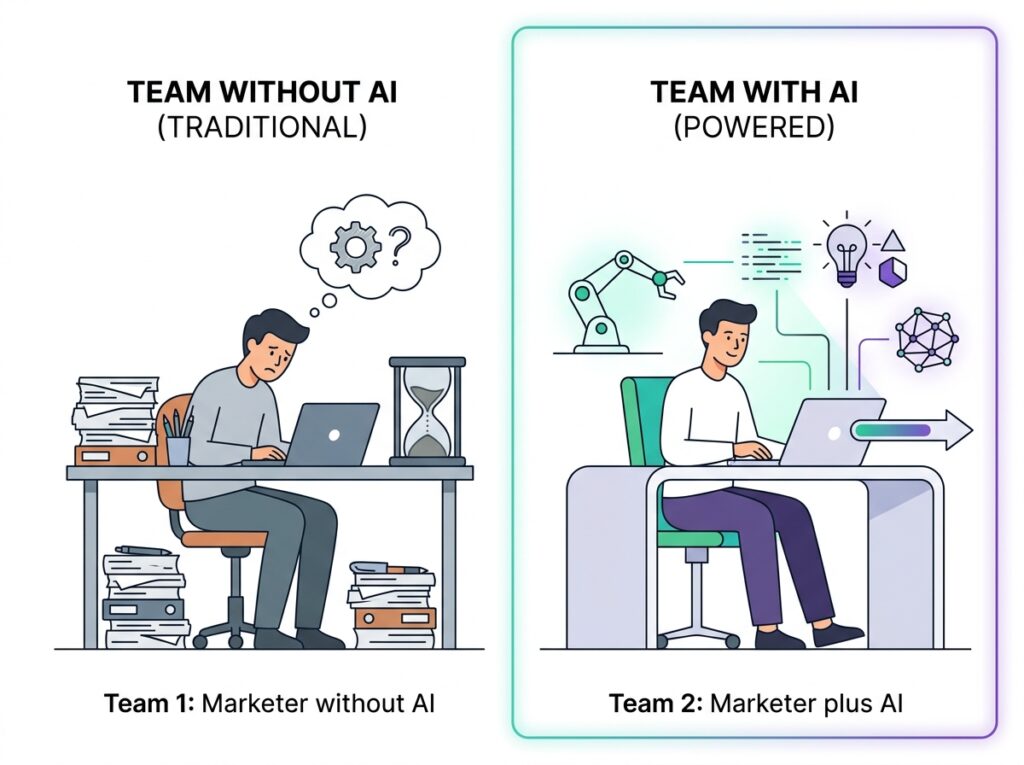
Walk into two different marketing teams today and you’ll see two very different realities. In one, AI tools are treated as a threat or a gimmick — used occasionally, distrusted, kept away from anything that matters. In the other, AI has quietly become part of the daily workflow: drafting first versions of ad copy, generating creative variations for testing, analyzing campaign data for patterns a human would take hours to spot, summarizing research, and handling the repetitive first sixty percent of nearly every task.
The second team isn’t working with fewer people doing more thinking-heavy work. The first team is quietly falling behind on speed, output volume, and — counterintuitively — creative quality, because their people are still burning hours on tasks that no longer need to consume that much time.
That’s the actual disruption happening in the industry right now. It’s not human versus machine. It’s marketer-plus-AI versus marketer-without-it, and the gap between those two groups is widening every quarter.
WHAT AI IS ACTUALLY GOOD AT (AND ISN'T)
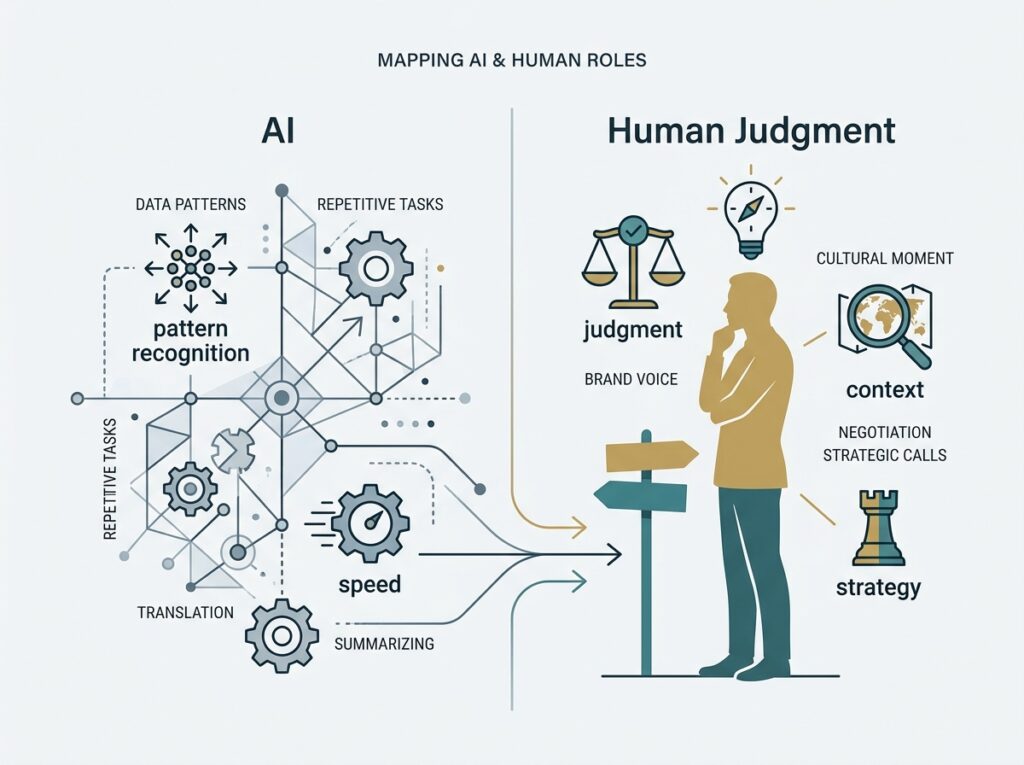
It helps to be specific here, because a lot of the fear comes from treating AI as one undefined, all-powerful force rather than a set of tools with real strengths and real limits. AI is genuinely excellent at pattern recognition across large amounts of data — spotting which ad creative is underperforming before a human would notice, or which customer segment is quietly churning. It’s excellent at speed on repetitive, well-defined tasks: generating ten headline variations, summarizing a hundred customer reviews, translating a campaign into another language, drafting a first version of nearly any piece of written content.
What it’s still genuinely bad at is judgment — knowing which of those ten headlines actually fits the brand’s voice and the cultural moment, understanding why a campaign that performed brilliantly for one client would embarrass another, reading a room, negotiating a client relationship, or making the strategic call about which market to enter next. Those decisions require context, taste, and accountability an AI model simply doesn’t have. The marketers thriving right now aren’t the ones with the most technical AI skills. They’re the ones who’ve correctly mapped which parts of their job belong to which side of that line, and rebuilt their workflow around it.
WHAT THIS ACTUALLY LOOKS LIKE DAY TO DAY
- A content strategist uses AI to generate a first draft and ten headline variations in minutes, then spends their saved time on the part that actually needs a human — sharpening the angle, checking it against brand voice, and deciding which version genuinely fits the audience.
- A performance marketer uses AI to analyze a week’s worth of campaign data across a dozen ad sets, surfacing the two or three patterns worth acting on, then spends their time on the strategic decision of what to test next rather than manually scrolling through spreadsheets.
- A social media manager uses AI to generate a month’s worth of caption drafts and content ideas in a single sitting, then spends the freed-up time actually engaging with the community, replying to comments, and building the relationships an algorithm can’t fake.
- A brand strategist uses AI to summarize competitor positioning across twenty websites in an afternoon instead of a week, then spends that recovered time on the harder, more valuable work of actually forming an opinion about what it means.
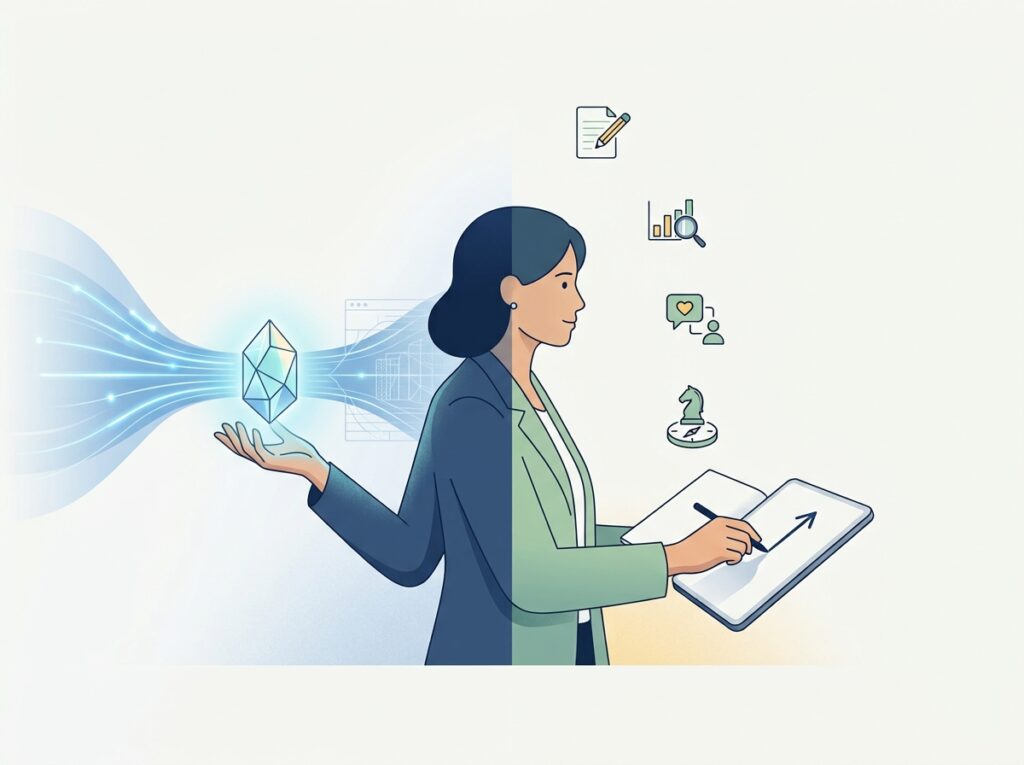
Notice the pattern. In every case, AI removes the slow, repetitive first draft of the work. The human still does the part that requires judgment, taste, and accountability. Nobody in these examples got replaced. They got faster, and the work they’re now spending their time on is the work that was always the actual point of hiring a strategist in the first place.
WHY AGENCIES ARE REBUILDING AROUND THIS
This shift isn’t optional for agencies anymore, and clients are starting to notice which ones have made the change. A campaign that used to take three weeks to plan, produce, and launch can now move in a fraction of that time when AI tools handle research, first drafts, and data analysis — freeing the actual strategists and creatives to spend their time where it counts. That speed compounds. More tests get run. More data comes back faster. Campaigns improve quicker, because the feedback loop is shorter.
Agencies still running the old workflow, where every draft, every variation, and every report is built entirely by hand, aren’t just slower. They’re also, ironically, producing less creative, less tested work — because all their team’s time is spent on production instead of on the strategic decisions that actually move a campaign’s performance.
THE SKILL THAT ACTUALLY MATTERS NOW

If there’s one skill worth building right now, it’s not “knowing how to use AI tools” in some generic sense — that part is genuinely easy to pick up. It’s knowing how to direct them well: asking the right questions, giving the right context, and — most importantly — knowing when to override the output because it’s technically correct but strategically wrong for this specific brand, this specific audience, this specific moment.
That’s a judgment skill, not a technical one, and it’s exactly the kind of skill that gets sharper with experience, not replaced by it.
There’s a useful analogy here to how design software changed graphic design decades ago. Tools like Photoshop didn’t eliminate designers — they eliminated the manual, mechanical parts of the job, and raised the bar for what a designer was expected to produce with the time that freed up. Nobody looks back and says design software “replaced designers.” It replaced a version of the job that no longer needed to exist, and the designers who adapted early became more valuable, not less. AI in marketing is following the exact same arc, just moving considerably faster.
WHERE THIS LEAVES MARKETERS
The honest version of this story isn’t as dramatic as “AI is coming for your job,” but it’s more useful. The tasks disappearing are the ones nobody particularly enjoyed doing anyway — the repetitive drafts, the manual data pulls, the first-pass research. What’s left is the work that actually requires a human: strategy, judgment, relationships, and taste. Marketers who lean into that shift aren’t being replaced. They’re becoming considerably more valuable because they can now do in a day what used to take a week, and spend the rest of that time on the work only a person can actually do.
Digital Hike has already rebuilt its own workflows around this shift — pairing AI-driven speed with the strategy, creative judgment, and industry experience that no model can replicate. If you want a marketing partner who’s actually adapted to this moment instead of just talking about it, book a free strategy call and see it in practice.