


How to Rank Higher on Google: 8 SEO Strategies That Work in 2026
Let’s be honest — everyone wants to “rank higher on Google.” Say it enough times in a meeting and it starts to sound like a magic spell. But actually doing it? That’s a different story, and it’s gotten harder to fake your way through it.
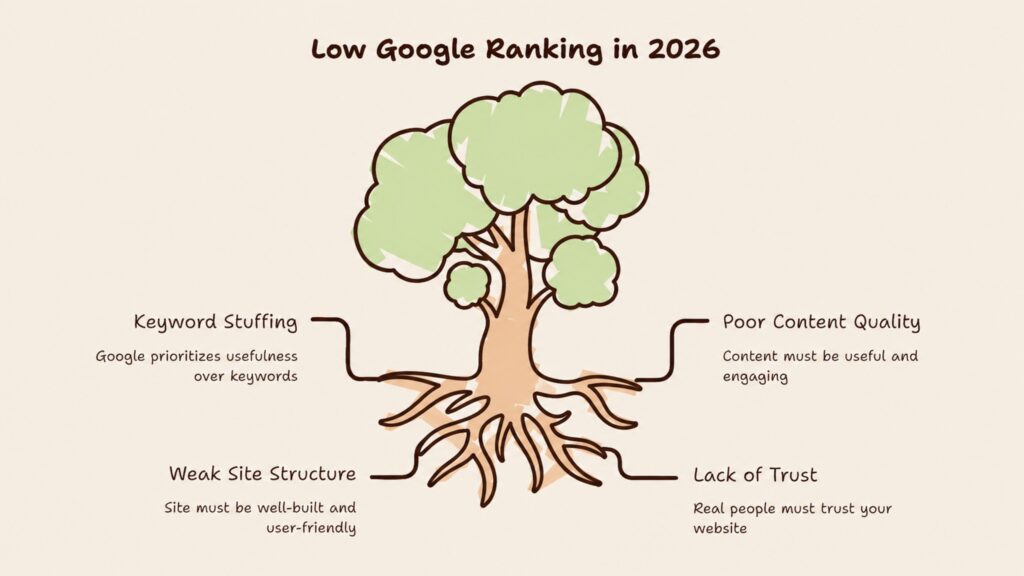
A few years back, you could stuff a page with a keyword fifteen times and watch it climb the rankings. Try that today and you’ll probably do more harm than good. Google’s gotten a lot better at telling the difference between a page that was built for search engines and a page that was built for actual people.
So what does work in 2026? Honestly, nothing fancy. It’s mostly about doing the fundamentals properly, and doing them consistently instead of once and forgetting about them. Here are eight things that are genuinely making a difference for the businesses we work with.
1. Figure Out Why People Are Searching, Not Just What They're Typing
This is the mistake that trips up almost everyone starting out. You pick a keyword, you write a page around it, and you never stop to ask: what is this person actually trying to do?
Here’s a simple example. Two people search almost identical phrases:
“best digital marketing agency”
“what is digital marketing”
The first person is probably close to hiring someone. The second person just wants a basic explanation. If you write the same type of page for both, you’re going to disappoint one of them maybe both.
Before you write a single word, sit down and think it through. What’s the person hoping to find? Are they trying to buy something, compare options, or just learn? What would make them think, “okay, this actually answered my question”? Get that part right and the rest of your SEO has something to build on.
2. Stop Publishing Content Just to Publish Something
There’s a temptation to churn out article after article because someone said “content is king” once and it stuck. But quantity without quality doesn’t move you anywhere.
A headline like “10 Benefits of Digital Marketing” has been written a thousand times over. Nobody needs your version of it unless you’re bringing something new to the table.
Compare that to something like “10 Digital Marketing Strategies We’d Actually Recommend to Small Businesses Right Now.” Now you’re adding a point of view.
What tends to make content genuinely worth reading:
- Examples pulled from real work, not hypotheticals
- An actual opinion, even if it’s a little unconventional
- Numbers or data you gathered yourself
- A case study with a real before-and-after
- Screenshots or walkthroughs instead of vague descriptions
If someone finishes reading and feels like they got something out of it, you’re doing this right.
3. Use Keywords the Way You'd Actually Talk
Keywords still matter — Google needs some signal to understand what your page is about. But repeating the same phrase over and over just reads badly now, and it doesn’t even help you the way it used to.
The better approach: pick your main keyword for a page, and let it show up naturally in the title, the main heading, a subheading or two, the intro, and scattered through the body. Bring in related terms too — the phrases people naturally use when they’re talking about the same topic.
Say you’re writing for “digital marketing agency in Lucknow.” That page will probably end up mentioning things like SEO services, Google Ads, social media marketing, and lead generation anyway, because that’s what someone searching that phrase actually cares about. You don’t have to force it.
If a sentence sounds awkward because you crammed a keyword into it, rewrite the sentence. Every time.
4. Fix What's Happening Behind the Scenes on Your Website
You can write the best article in your entire industry, and it still won’t rank if Google can’t crawl your site properly, or if your pages take eight seconds to load.
This is the unglamorous part of SEO, but it matters:
- Whether search engines can actually find and index your pages
- How your site is structured and organized
- Your sitemap and robots.txt file
- Internal linking between pages
- Whether your site works well on mobile
- Page load speed
- HTTPS
- Structured data markup
Every so often, check whether your important pages are actually showing up in Google’s index. It’s surprisingly common for a page to just… not be there, and nobody notices for months. A clean, fast, well-organized site makes everything else you do work better.
5. Link Your Own Pages Together
This is one of the easiest wins in SEO, and somehow it’s still one of the most ignored.
If you’ve written related content, connect it. A guide on ranking higher on Google should probably link out to a piece on technical SEO, another on local SEO, maybe one on keyword research. It costs you five minutes per link and it does two things at once: it helps readers find more of what you’ve written, and it helps Google understand how your pages relate to each other.
Picture your site less like a pile of separate documents and more like a bookshelf where things are actually organized by topic. That’s the goal.
6. Take Local SEO Seriously If You Serve a Specific Area
If your business operates out of a particular city or region, local SEO is one of the highest-return things you can spend time on. And a lot of it comes down to consistency more than cleverness.
Make sure the basics are right everywhere your business appears online:
- Your Google Business Profile filled out completely, kept current
- Local directory listings
- Pages on your site built around specific locations you serve
- Customer reviews (ask happy customers, don’t wait for them to volunteer)
- Local keyword targeting
- Contact information that matches, word for word, across every platform
A business in Lucknow shouldn’t only be targeting “digital marketing agency.” They should also have content built around “digital marketing agency in Lucknow” or “SEO services for businesses in Lucknow.” You’re not trying to sprinkle the city name into every sentence — you just need it to be obvious where you operate.
7. Go After Backlinks That Are Actually Worth Something
Backlinks still count, but the old “get as many as possible” mindset is outdated and honestly kind of risky. A handful of links from sites people actually trust will do more for you than five hundred links from random directories nobody’s ever heard of.
Worth putting energy into:
- Getting mentioned in industry publications
- Relevant, well-regarded business directories
- Writing guest posts for sites your audience already reads
- Digital PR — pitching journalists, not just bloggers
- Partnering with other businesses in your space
- Publishing original research that people actually want to cite
If you put out something genuinely original say, a small industry survey with real numbers other sites referencing it will bring you both links and a bit of credibility you can’t buy. Focus on relevance over raw numbers, every time.
8. Watch the Data and Actually Act on It
Publishing content isn’t the finish line. Once it’s live, your job becomes watching how it performs and figuring out what needs fixing.
Keep an eye on things like:
- Clicks and impressions
- The actual search terms bringing people to the page
- Where you’re ranking, and whether that’s moving
- How long people stay and what they do once they land
- Whether any of it is turning into leads or sales
Google Search Console will tell you most of this for free. You might find a page pulling in impressions for a great keyword but stuck at position 11 or 12 — frustratingly close to page one. That’s usually a sign it’s time to go back in: update the content, add a few internal links, tighten up the intro, or rework it to better match what people are actually searching for.
Treat this as an ongoing back-and-forth, not a one-time project you check off.
Final Thoughts
The above video gives a clear understanding on how to work on SEO to Rank on Google. Start by understanding what your audience is actually searching for. Write things worth their time. Keep your site technically healthy. Go after links that mean something. Connect your own content thoughtfully. And keep circling back to the data instead of setting content live and forgetting about it.
The businesses that stick with this quietly, consistently, over months and years are the ones that end up with the kind of organic visibility that doesn’t disappear the moment they stop paying attention to it.
Frequently Asked Questions
How long does it actually take to rank higher on Google?
Depends a lot on your industry and how competitive it is, but most businesses start seeing real movement somewhere between three and six months in. Some crowded niches take longer, and that’s normal don’t panic if month two looks quiet.
Is keyword research still worth doing in 2026?
Yes, absolutely. It tells you what people are actually looking for and how they phrase it. What’s changed is how you use that information — it should shape your content, not control every single sentence you write.
How often should old content get updated?
Check your top-performing pages every few months, and pay special attention to anything sitting just outside the top results. If a page is losing traffic or has outdated information, it’s worth revisiting.
Do backlinks still matter?
They do, but quality matters far more than volume. A few links from sites people actually trust will outperform a huge pile of low-quality ones every time.
What's the most common local SEO mistake?
Inconsistent business details across the web — a different phone number here, a slightly different address there. It sounds small, but it genuinely hurts local rankings. Fixing it is one of the easiest wins available.
Can a small business really outrank bigger competitors?
Yes, more often than people think. Local SEO, genuine expertise in a niche, and content that’s actually useful can help a smaller business beat a bigger one, especially for specific or location-based searches.
Ready to Rank Higher on Google?
Ranking is only half the story. If you’re driving traffic but still not sure whether your website is actually turning visitors into leads or quietly sending them away that’s worth figuring out before you spend more on SEO or ads.
Book a free consultation with Digital Hike, and we’ll look at your website, understand your offer, audience, and goals, and tell you honestly what could be holding your rankings and your conversions back.
Call us at 9187138887 / 9632811130 or visit thedigitalhike.com to get started.