


Why Growing Businesses Need One Growth Partner, Not Ten Different Vendors
There’s a pattern almost every growing business goes through eventually. It starts small — maybe a freelance designer for the logo, a separate agency for ads, another one for the website, an SEO consultant hired off a recommendation, and a social media manager working out of a different city entirely. Each vendor does their piece reasonably well. And yet, somehow, the brand still feels disjointed. The website doesn’t match the ad creatives. The SEO strategy has no idea what the paid campaigns are pushing. Nobody in the chain is actually responsible for whether the business grows — everyone’s just responsible for their slice of it.
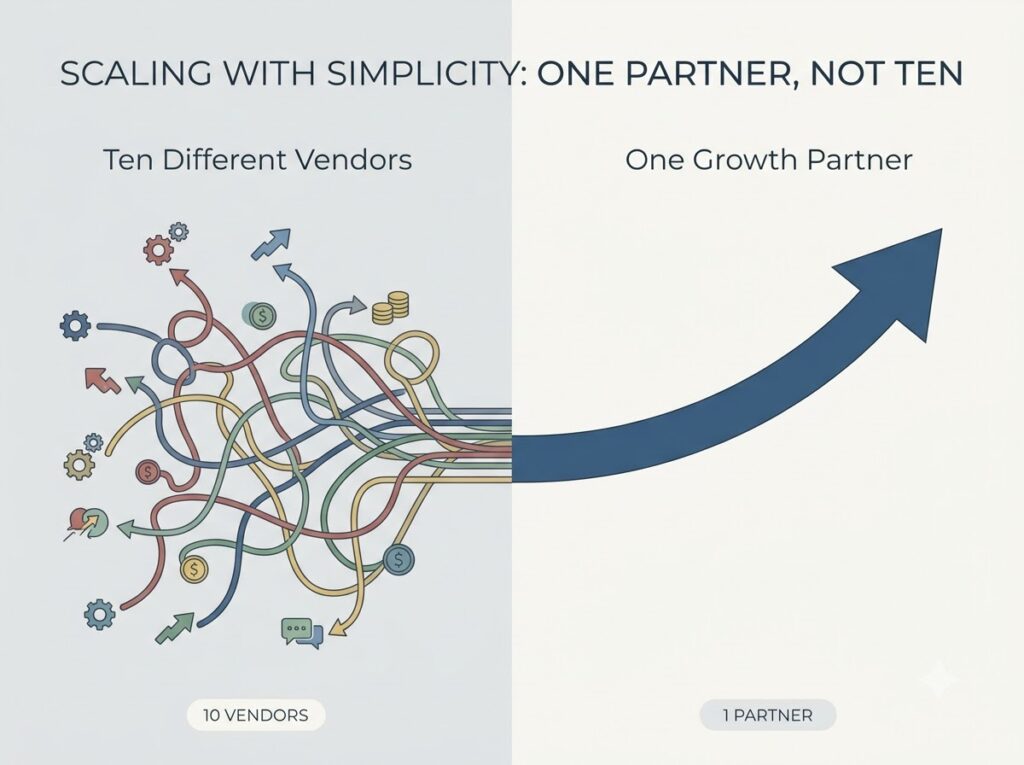
This is one of the most common, least talked-about reasons marketing budgets underperform. Not bad vendors, necessarily — just too many of them, with no single team owning the outcome end to end.
The Cost of Fragmented Marketing
When five different vendors handle five different pieces of a brand’s growth, something inevitably falls through the cracks. The branding agency designs a beautiful identity without knowing how the performance marketing team plans to run ads against it. The web developer builds a site that looks great but wasn’t built with conversion or SEO structure in mind. The social media manager posts content that has nothing to do with what the paid ads are promoting that week.
Nobody is lying about doing their job — they’re just not talking to each other, because there’s no reason for them to. And the business owner ends up playing project manager between five vendors who don’t share context, don’t share data, and often don’t even know what the others are working on. This is exactly the gap a full-stack digital partner is built to close.
What "Full-Stack" Actually Means
A generic marketing playbook doesn’t work the same way for a real estate developer as it does for a D2C skincare brand, and it certainly doesn’t look the same for a healthcare platform or a SaaS company. Different industries have different buying cycles, different trust requirements, and different customer journeys — which is exactly why working across a genuinely wide range of sectors matters. Digital Hike has built and scaled strategies across:
E-Commerce
From performance-driven Meta ad campaigns to full-funnel builds that turn browsers into repeat buyers.
Real Estate
Immersive 3D walkthroughs paired with targeted lead-generation funnels that convert high-intent traffic into on-ground site visits and sales, as seen with projects like RR Group’s premium townships in Lucknow.
SaaS & Technology
Go-to-market strategy and demand generation for products that need to explain complex value in a way non-technical buyers still understand.
EdTech
Enrollment-focused funnels and content built around long consideration cycles and parent-plus-student decision-making.
FinTech
Trust-driven messaging and compliant, conversion-focused campaigns for a category where hesitation is the biggest barrier to sign-up.
Gaming & Entertainment
Community-first content and campaigns built around engagement rather than a single hard sell.
Healthcare & Medical
Nationwide visibility and patient acquisition strategy, including work with Fair Health Price to scale a pan-India medical marketplace and support treatment bookings and hospital comparisons at scale.
Fashion & Apparel
High-performing ad campaigns that have delivered strong ROAS for brands like Coffxn Attirez, built around trend-driven creative and fast-moving product cycles.
Travel and Retail Brands
Brand-building and performance campaigns tailored to seasonal demand and experience-driven buying decisions.
The reason this range matters isn’t just variety for its own sake. Every one of these sectors requires a different rhythm — real estate sales cycles stretch over months, while a D2C flash sale needs to convert in days. A team that’s actually worked across these differences brings pattern recognition a single-industry specialist simply doesn’t have.
What Changes When One Team Owns the Whole Journey
When branding, creative, performance marketing, SEO, automation, and web development sit under one strategy instead of five disconnected vendors, a few things change immediately. Campaigns launch faster because there’s no waiting on five different approval chains. Messaging stays consistent because the same team that built the brand identity is the one writing the ad copy. And most importantly, there’s actual accountability — one team responsible for the full journey from a stranger’s first impression to a completed sale, not five teams each pointing at the others when something underperforms.
This is the real value of a strategy-first, full-stack approach. It’s not about consolidating vendors for the sake of a tidier invoice. It’s about making sure every piece of a brand’s growth — the way it looks, the way it’s found, the way it’s advertised, and the systems that keep customers engaged after the sale — is built by people who understand how all of it fits together.
The Takeaway
Fragmented marketing isn’t usually the result of bad decisions — it’s what happens gradually, one vendor at a time, until a business wakes up managing a dozen relationships instead of one strategy. Businesses that consolidate this into a single, full-stack growth partner tend to move faster, stay more consistent, and spend their budget more efficiently, simply because everyone involved is working toward the same outcome instead of their own individual slice of it.
If your marketing feels like it’s being pulled in five directions by five different vendors, that’s usually the clearest sign it’s time for one team to own the whole journey instead.