
YOUR ADS AREN'T BROKEN. YOUR OFFER IS.
“Our ads stopped working.” It’s one of the most common lines a performance marketing agency hears, usually followed by a request to fix the targeting, refresh the creative, or increase the budget. Nine times out of ten, none of those are the actual problem. The ad account is doing exactly what it’s supposed to do — putting the right offer in front of the right person at a reasonable cost. If that person still isn’t buying, the ad isn’t broken. What’s underneath it is.
WHAT AN AD CAN AND CAN'T FIX
A well-run ad campaign can get your offer seen by the right audience, at the right moment, for a fair price. That’s genuinely difficult, and it’s real, valuable work. But no amount of targeting precision or creative polish can make someone want something they don’t actually want. Ads amplify. They don’t manufacture desire out of nothing.
This is the part that’s uncomfortable for a lot of founders to hear, because it’s much easier to blame a platform’s algorithm than to question the product, the price, or the pitch. But the data tells the story pretty clearly if you’re willing to look at it honestly.
FIVE SIGNS IT'S THE OFFER, NOT THE ADS
High click-through rate, low conversion rate. People are curious enough to click, but something on the landing page or in the pricing makes them bounce. That’s not a targeting problem.
Cost per click is reasonable, but cost per purchase keeps climbing. The algorithm efficiently finds interested people. They’re just not converting once they land. The right people are already there.
Competitors with worse creative are outselling you. If a competitor with clearly weaker ads and design is still winning more customers, the gap usually isn’t execution. It’s positioning, pricing, or trust.
Repeat customers are rare. Ads can bring someone through the door once. If almost nobody comes back a second time, that’s a product or experience signal, not an ad account signal.
The sales team hears the same objection over and over. If prospects keep raising the same doubts — price, delivery time, lack of trust — no amount of ad spend can fix a message the market keeps rejecting.
WHAT "FIXING THE OFFER" ACTUALLY MEANS
This isn’t necessarily about rebuilding the entire product. Usually, it’s smaller and more specific than that. It might mean reworking how the value is framed — the same product, described around the actual outcome the customer wants instead of a list of features nobody outside the industry understands. It means addressing the specific objection showing up in sales calls directly on the landing page, rather than hoping it doesn’t come up. It might mean the price is genuinely misaligned with the perceived value, and no clever ad copy is going to close that gap.
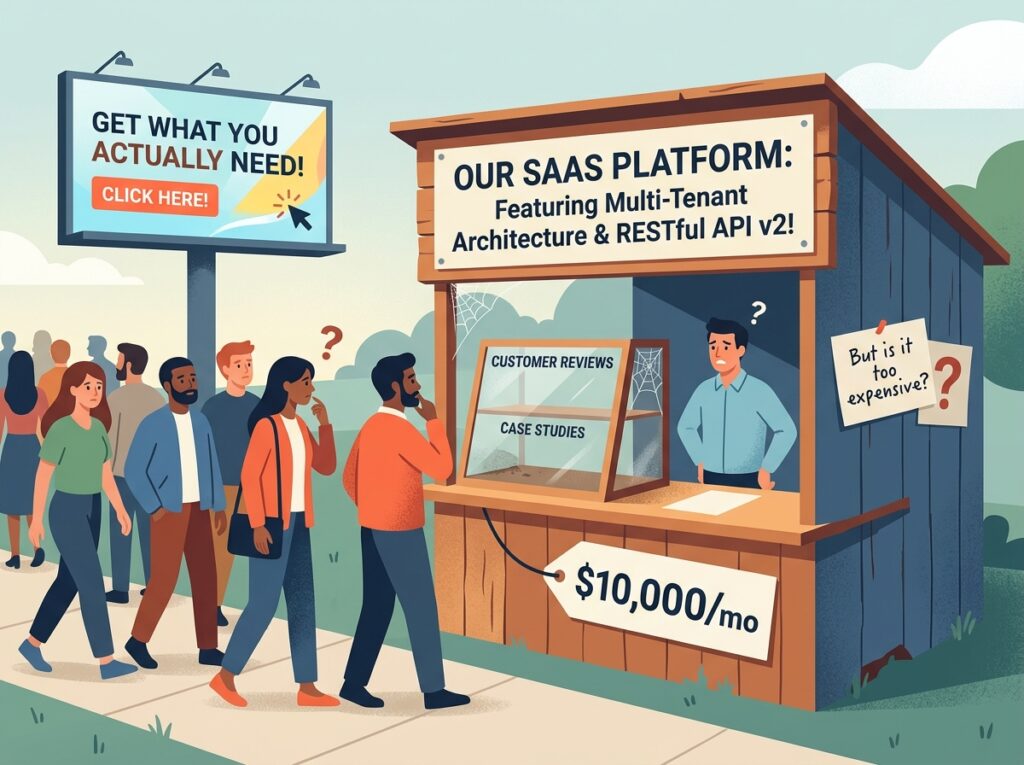
Sometimes it’s about proof. A page with zero reviews, no case studies, and no social proof is asking a stranger to trust a business with nothing to back that trust up. Ads can bring a thousand strangers to that page every day. If nothing on it earns their trust, the ad spend is just funding an expensive way to discover that the offer needs work.
WHERE DIGITAL HIKE SEES THIS PLAY OUT
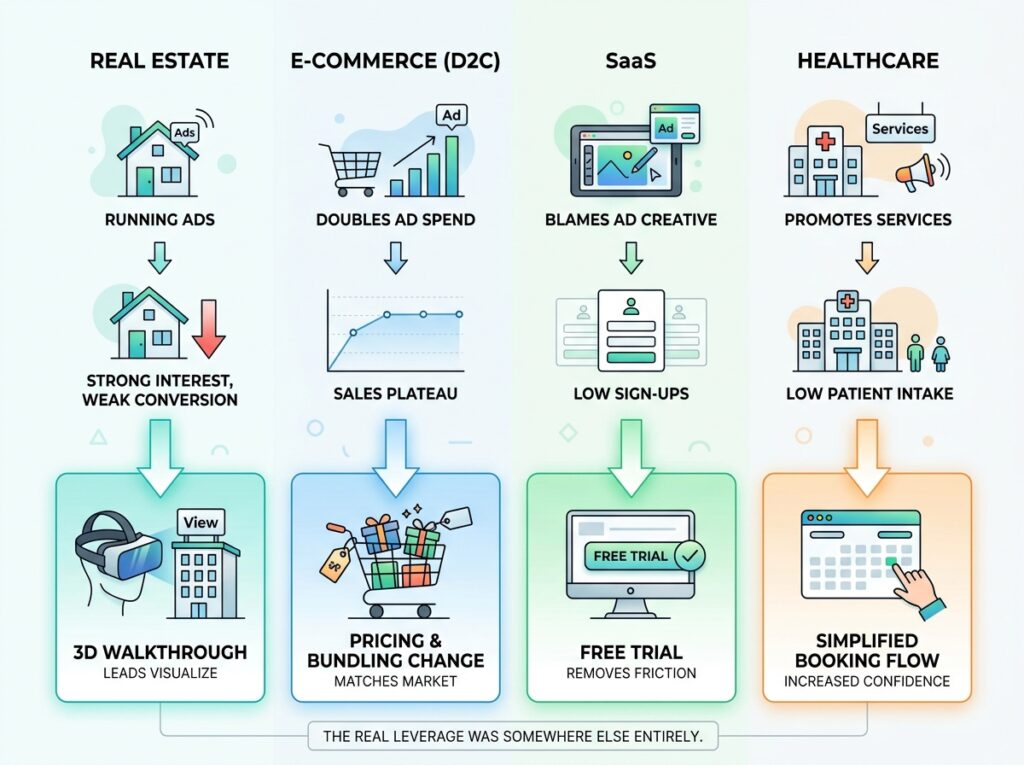
Across industries — e-commerce, real estate, SaaS, healthcare — the pattern repeats with small variations. A real estate developer runs ads to a property with strong interest but weak conversion, and the fix turns out to be a 3D walkthrough that finally lets a lead visualize what they’re buying, not a bigger media budget. A D2C brand doubles ad spend chasing a sales plateau, and the fix turns out to be a pricing and bundling change that finally matches what the market is willing to pay. A SaaS company blames its ad creative for low sign-ups, and the fix turns out to be a free trial removing the friction that was quietly killing conversions the whole time. In every one of these cases, the ad account itself needed only minor adjustments. The real leverage was somewhere else entirely.
HOW TO DIAGNOSE THIS IN YOUR OWN BUSINESS
Pull up your funnel data and look at where people actually drop off — not just the final sales number. If they’re dropping at the click stage, that’s a targeting or creative issue, and it’s worth testing new audiences or hooks. If they’re dropping after landing on your page, that’s rarely an ads problem. That’s a page, price, or trust problem, and no amount of extra spend fixes it. Talk to your sales team, or read through your DMs and customer support chats, and look for the objection that shows up again and again. That repeated objection is usually your real answer, sitting in plain sight, ignored because it’s easier to tweak an ad than to rework a pitch.
Performance marketing works best as a magnifying glass — it makes whatever is true about your offer more visible, faster. A strong offer under good ads grows quickly. A weak offer under good ads just fails faster and more expensively than it would have otherwise. Before increasing another budget, it’s worth being honest about which one you’re actually running. It also helps to separate two questions that often get blurred into one: “is this a bad product” and “is this a badly communicated product.” Most of the time it’s the second one, and it’s a far easier problem to solve. A genuinely good product can still lose to a mediocre one that simply explains its value more clearly, addresses objections earlier, and makes the buying decision feel safer. That’s not a flaw in the product — it’s a gap in the story being told around it, and it’s usually fixable in weeks, not months.
Digital Hike’s performance marketing team looks at the full funnel, not just the ad account, before recommending a single rupee of extra spend. Book a free strategy call, and we’ll help you find out whether it’s really the ads, or something underneath them.