
No 1 Reason ChatGPT Is Stealing Your Website Traffic
Somewhere in the last year, a strange thing started happening inside marketing dashboards across the country. Organic traffic, which used to climb steadily with every new blog post, flattened out. Sometimes it dropped. The keywords were still ranking. The content was still good. So what changed? The honest answer: the reader stopped clicking, because they didn’t have to anymore.
The rise of the ANSWER, not the LINK
Search used to work in one predictable way. You typed a question, Google handed you ten blue links, and you clicked through to find your answer. That model is quietly breaking apart. AI Overviews now sit at the top of a large share of Google searches, generating a direct answer pulled from multiple sources — often good enough that the person never scrolls further. On top of that, an entirely new category of search has grown fast: people are now asking ChatGPT, Perplexity, and Gemini their questions directly, skipping the search engine altogether. Both of these behaviours point in the same direction. The search engine result page isn’t the finish line anymore. It’s a summary screen. And your website traffic is the thing quietly disappearing on the other side of that summary.
Is it just a "BIG BRAND" problem?
It’s tempting to assume this only affects huge publishers and news sites. It doesn’t. Local service businesses, D2C brands, SaaS products, and real estate developers are all seeing the same pattern: a question that used to send someone to their comparison page now gets answered inside an AI chat window, complete with a summary of pricing, features, or reviews that the business never got to control the framing of. That’s the part that should actually worry you. It’s not just that the click disappeared. It’s that an AI model is now forming your customer’s first impression of your business, using whatever information it can find — and if your website, reviews, and content aren’t structured in a way these models can read and trust, someone else’s information is shaping that first impression instead.
Enter GEO : Generative Engine Optimization
SEO spent two decades teaching businesses how to be found by a search engine. The next few years are about being understood and trusted by an AI model — a discipline people are starting to call GEO, or generative engine optimization. It borrows a lot from traditional SEO, but the target is different: instead of ranking #1 on a results page, the goal is being the source an AI system chooses to cite, quote, or summarize from when it answers a question about your industry.
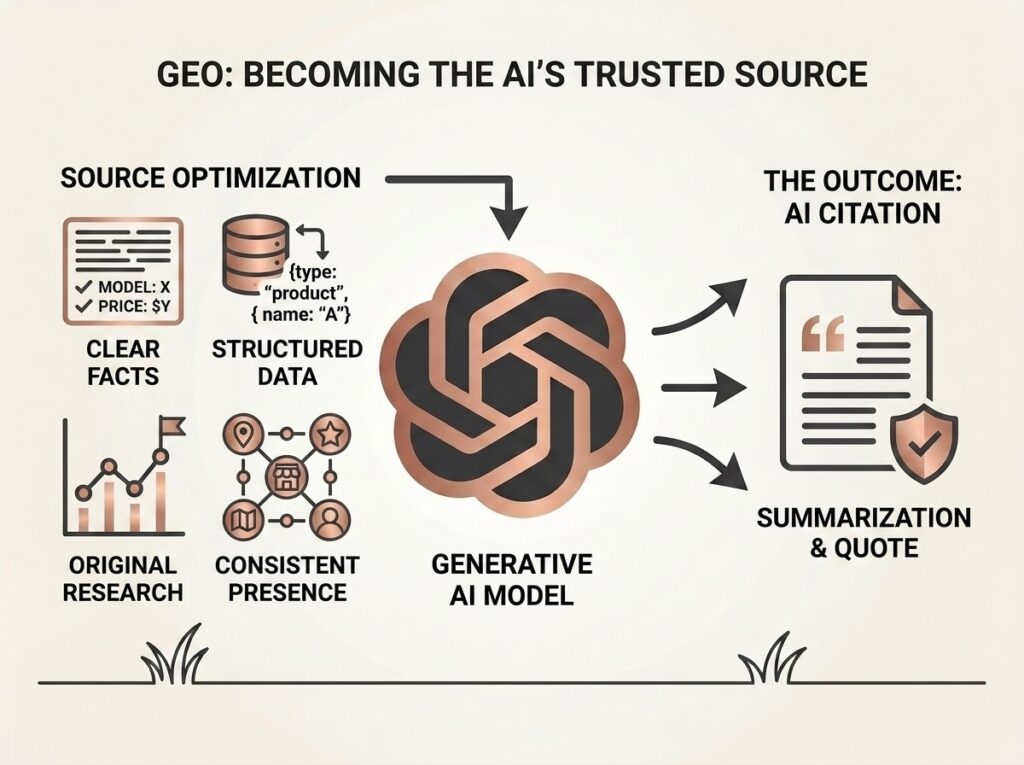
- Clarity over cleverness — AI models extract facts, not vibes. A page that clearly states what you offer, to whom, and at what price gets pulled into answers far more often than a page full of clever brand language.
- Structured data and schema markup — this is literally how you hand an AI model a labeled, machine-readable version of your content instead of making it guess.
- Consistency across the web — your business name, offer, and details need to match across your website, directories, and review platforms, because AI models cross-reference sources to decide what to trust.
- Original data and expertise — genuinely new information, like your own research, statistics, or case studies, is far more likely to get cited than content that repeats what’s already everywhere online.
- Reviews and third-party mentions — AI models weigh what other sources say about you almost as heavily as what you say about yourself.
What this means for Content Strategy?
This doesn’t mean traditional SEO is obsolete — rankings still matter, and a huge share of clicks still come from traditional results. But treating SEO and GEO as the same task is a mistake that’s already showing up in traffic reports across the country. The businesses adapting fastest are running both strategies side by side: optimizing pages to rank, while also restructuring content so an AI model can lift a clear, accurate, well-sourced answer straight out of it.
In practice, that means auditing your site for a few uncomfortable questions. Does your homepage state clearly, in plain language, what you do and for whom? Is your pricing or service information easy for a machine to extract, or buried inside a PDF or an image? Do your reviews and directory listings say the same thing your website says? Would an AI model reading your “About” page be able to accurately summarize your business?
The Business getting ahead of this
Every major shift in search has rewarded the businesses that moved early and punished the ones that waited for certainty. The move from desktop to mobile search did this. The rise of local search did this. This shift is no different, except the window to adapt is shorter, because AI search adoption is moving faster than any previous transition in how people find information.
The traffic isn’t gone. It’s being redirected through a new layer, and the businesses that structure their content, data, and online presence for that layer are the ones who’ll still be visible — and trusted — six months from now, while their competitors wonder why the rankings look fine but the leads don’t.
Search is changing, but the goal remains the same: helping the right people discover your business and giving them enough confidence to take the next step. Whether visitors find you through traditional search results, AI-generated answers, or referrals, your website, content, and overall digital presence all play a crucial role in building trust and driving conversions. Businesses that continuously refine their online strategy will be far better positioned to adapt to these changes than those relying on outdated tactics.
If you’re unsure how your website is performing or whether your current SEO and content strategy is still aligned with the way people search today, Digital Hike can help. Book a free strategy call, and our team will review your website, identify opportunities to improve your online visibility, user experience, and conversions, and provide actionable recommendations to help your business grow in an increasingly AI-driven digital landscape.
If your website traffic has started declining, you’re not alone. Businesses across industries are noticing fewer clicks from search engines, even when their rankings haven’t changed much.
The biggest reason? People are getting answers without ever visiting your website.
AI tools like ChatGPT have changed how people search for information. Instead of typing a query into Google and clicking through multiple websites, users can ask ChatGPT a question and receive a complete, conversational answer in seconds. For many informational searches, that’s enough.
This doesn’t mean your website has become less valuable. It means user behavior has changed.
Search Has Evolved
Traditionally, search worked like this:
- User searches on Google.
- Google shows a list of websites.
- User clicks one or more links.
- Website receives traffic.
Today, the journey often looks different:
- User asks ChatGPT or another AI assistant.
- AI summarizes information from multiple sources.
- User gets the answer instantly.
- No website visit is needed.
For businesses that rely heavily on blog traffic, this shift can significantly reduce clicks.
Why This Matters for Businesses
Less website traffic doesn’t just mean fewer page views. It can also affect:
- Lead generation
- Brand visibility
- Product discovery
- Ad revenue
- Organic conversions
If your content only answers simple questions that AI can summarize easily, users may never reach your website.
The New SEO Reality
SEO is no longer just about ranking #1 on Google.
Today, your content needs to be useful enough for both search engines and AI systems. Businesses are increasingly optimizing for Generative Engine Optimization (GEO)—creating content that is accurate, trustworthy, and comprehensive so AI platforms recognize it as a reliable source.
This means focusing on:
- Original insights and expertise
- Real case studies
- Industry-specific knowledge
- Updated information
- Strong brand authority
Generic articles are becoming easier for AI to replace.
How to Stay Ahead
Instead of competing with AI, create content that goes beyond basic answers.
Publish detailed guides, original research, customer success stories, comparison articles, expert opinions, videos, and interactive tools. These offer value that AI summaries often cannot fully replace.
It’s also important to build your brand beyond search by investing in email marketing, social media, communities, and direct customer relationships.
The Bottom Line
ChatGPT isn’t intentionally “stealing” your website traffic. It’s changing how people access information. The businesses that adapt to this shift will continue to grow, while those relying only on traditional SEO may struggle to maintain visibility.
The future belongs to brands that create unique, trustworthy, and experience-driven content. If your website provides real value instead of repeating information available everywhere else, people—and AI—will continue to recognize it.